








Performance Design

You don’t need more effort. You need it working together.

Turn effort into results, not complexity.

Nexaura helps leaders understand why capable organizations can work harder without producing the performance they should — and design the conditions required for better performance.

Selected experience

Organizations Laurie has worked with across her career.

The Nexaura Negative Compounding Loop™

Well-intended interventions can create a Negative Compounding Loop.

A Negative Compounding Loop forms when a reasonable response to a visible problem creates new pressure elsewhere in the performance system. That pressure weakens performance, triggers another response and adds still more complexity and demand.

Leadership actions often have the right intent. The problem is that each choice creates consequences elsewhere in the performance system — and those consequences shape what leaders do next.

The Nexaura Negative Compounding Loop shows how reasonable leadership responses can create pressure elsewhere in the performance system, weaken results and trigger additional responses, complexity and demand.
What makes sense in each part can create a different result in the whole.
Direction
Execution
Capacity
Choices + commitmentscreate work
Workcompetes + interferes
Capacityis consumed
Decisions + executionslow
Resultsweaken
Leadership respondsmore work enters

The Nexaura Negative Compounding Loop™ is a proprietary component of Nexaura Performance Design. © 2026 Nexaura.

The goal is not simply to stop the loop. It is to reverse it.

When Direction, Execution and Capacity are designed together, each change can release capacity, strengthen what happens next and allow performance to compound positively.

The reframe

The problem is rarely where it first appears.

When performance slows, it is natural to look for the part that seems to be failing: the strategy, the structure, the technology, the team or the individual.

But the parts can all be working reasonably well and the organization can still underperform. The breakdown often sits in the interaction between them.

That is why normal interventions can improve the visible problem without improving overall performance — and sometimes make the underlying problem worse.

The symptom changes. The constraint moves. More effort enters. The loop continues.

When people are overloaded

Adding people can create relief — then consume leadership capacity.

New people reduce pressure at first. They also add decisions, handoffs, onboarding and coordination. If the work has not changed, more headcount can create another layer of demand on the people already holding the system together.
When work is too slow

Technology can make one step faster without making the organization faster.

One stage speeds up and the work reaches the next constraint sooner, where it waits. The local metric improves. The end-to-end result does not.

When people are burning out

Support can treat the symptom while the work keeps creating it.

Wellness and resilience programs may help people cope. But if priorities, roles, decisions and expectations stay the same, the design conditions creating the overload remain in place.

When the strategy looks wrong

Complexity can hide what made the strategy valuable in the first place.

Results disappoint, so leaders add priorities or borrow a competitor’s playbook. More change enters the system, making it even harder to see whether the organization’s own differentiator was ever being executed clearly.

The consequence

Improving the parts is not the same as improving the whole.

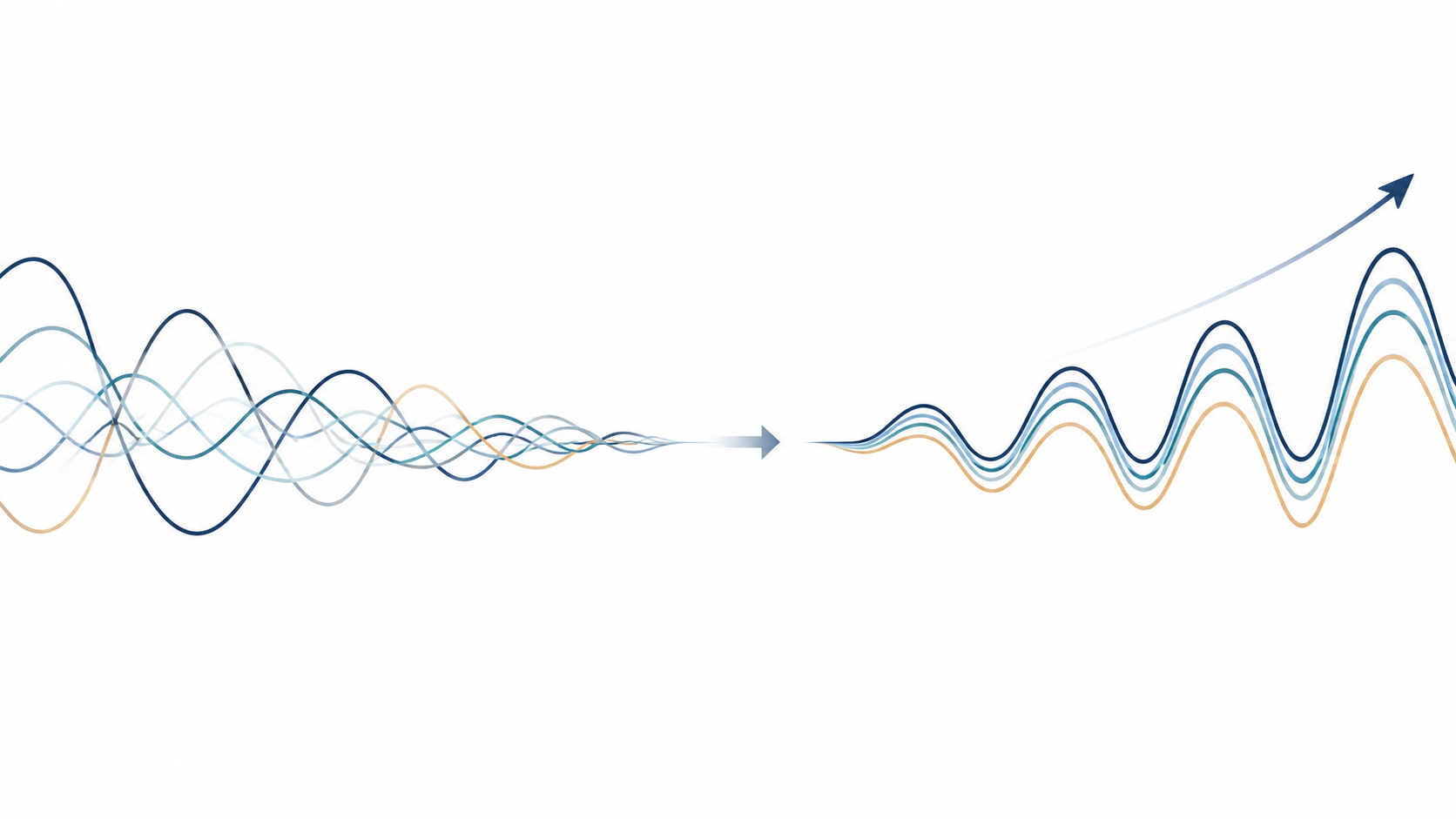
The interventions are not independent. Their effects interact. Effort can cancel out — or reinforce what is already there.

Multiple efforts cancelling before aligning and building together
When effort cancelsIndividually sensible actions pull against one another and reduce the total effect.
When effort reinforcesThe work is designed together so effort builds on effort and creates momentum.
Same effort. Different effect.
What makes Nexaura different

Performance Design changes where you look before deciding what to do.

Nexaura does not begin with a predetermined solution or assume the visible symptom is the problem. We start with the result that matters, find what is actually constraining it, and examine how Direction, Execution and Capacity are interacting around that constraint.

Direction

Where the organization is going, the choices being made, how clearly priorities guide decisions, and the leadership behaviour reinforcing them.

Execution

How structures, roles, systems, processes, technology and operating rhythms translate direction into results.

Capacity

What the organization and its people can realistically execute, absorb, adapt to and sustain.

Nexaura finds and designs the interactions other approaches tend to treat separately. The work may begin in one area, but it is never designed in isolation. The implications across the performance system stay in view.
NexMomentum™

Understand what is happening.Design what needs to change.Build what lasts.

NexMomentum™ is Nexaura’s applied method for moving from understanding the real performance constraint to embedding stronger conditions for performance.

01

Discover Potential

Identify what is working, what is constraining performance, and where effort is cancelling out. Make the critical choices about what matters most and align leaders on where to act first.

OutcomeDecide & Align
02

Design Alignment

Turn those choices into an integrated design across Direction, Execution and Capacity, then put the highest-leverage changes into motion.

OutcomeDesign & Implement
03

Elevate Performance

Use real performance evidence to refine what works, remove what is still getting in the way, and scale without recreating the constraint.

OutcomeRefine & Scale
04

Amplify Momentum

Build the operating capability, leadership habits and feedback loops that make stronger performance repeatable and allow momentum to compound.

OutcomeEmbed & Compound
Who we help

Different environments. Different challenges. The same performance system.

Organizations and teams operate through the same underlying conditions. The context may differ; Nexaura applies the same Performance Design method across every market.

SMBThe business has grown, but too much still depends on the owner or a small group of leaders.
GrowthThe company is getting larger, but its operating system is not scaling at the same rate.
EnterpriseInvestment and initiatives are substantial, but performance breaks between functions, systems and priorities.
WealthWealth has grown, but governance, decision-making and leadership readiness have not evolved at the same rate.
AthleticsThe talent is there, but the systems and conditions around it are not consistently translating potential into performance.

Potential is common. Performance is designed.

Insights

Follow the thinking.

Performance Design in writing, on LinkedIn and through selected media.

Substack

Performance Is Designed

Long-form thinking, research and practical reframes.

Sign up →
LinkedIn

Nexaura

Company updates and Performance Design thinking.

Follow →
Conversation

Bring the problem

If something important is harder than it should be, that is a useful place to start.

Start a conversation →
Start a conversation

Turn effort into results, not complexity.

If something important is becoming harder than it should be, bring the problem, the decision or the performance gap. We can start there.